Modern enterprises do not need another cloud pitch. They need a practical way to turn strategy into secure, reliable platforms that ship faster and cost less. This step-by-step playbook distils what works in 2025 for large organisations adopting or re-baselining an enterprise cloud computing strategy, with clear deliverables, controls, and metrics you can take to the board.
What your cloud strategy must achieve
- Speed with control, for example faster lead time and higher deployment frequency, without raising change failure rate.
- Reliability you can prove, defined by SLOs and error budgets rather than hopeful uptime claims.
- Security and compliance by design, not by audit panic.
- Cost predictability and efficiency, with showback and unit economics.
- A data foundation for analytics, AI and automation that respects sovereignty and privacy.
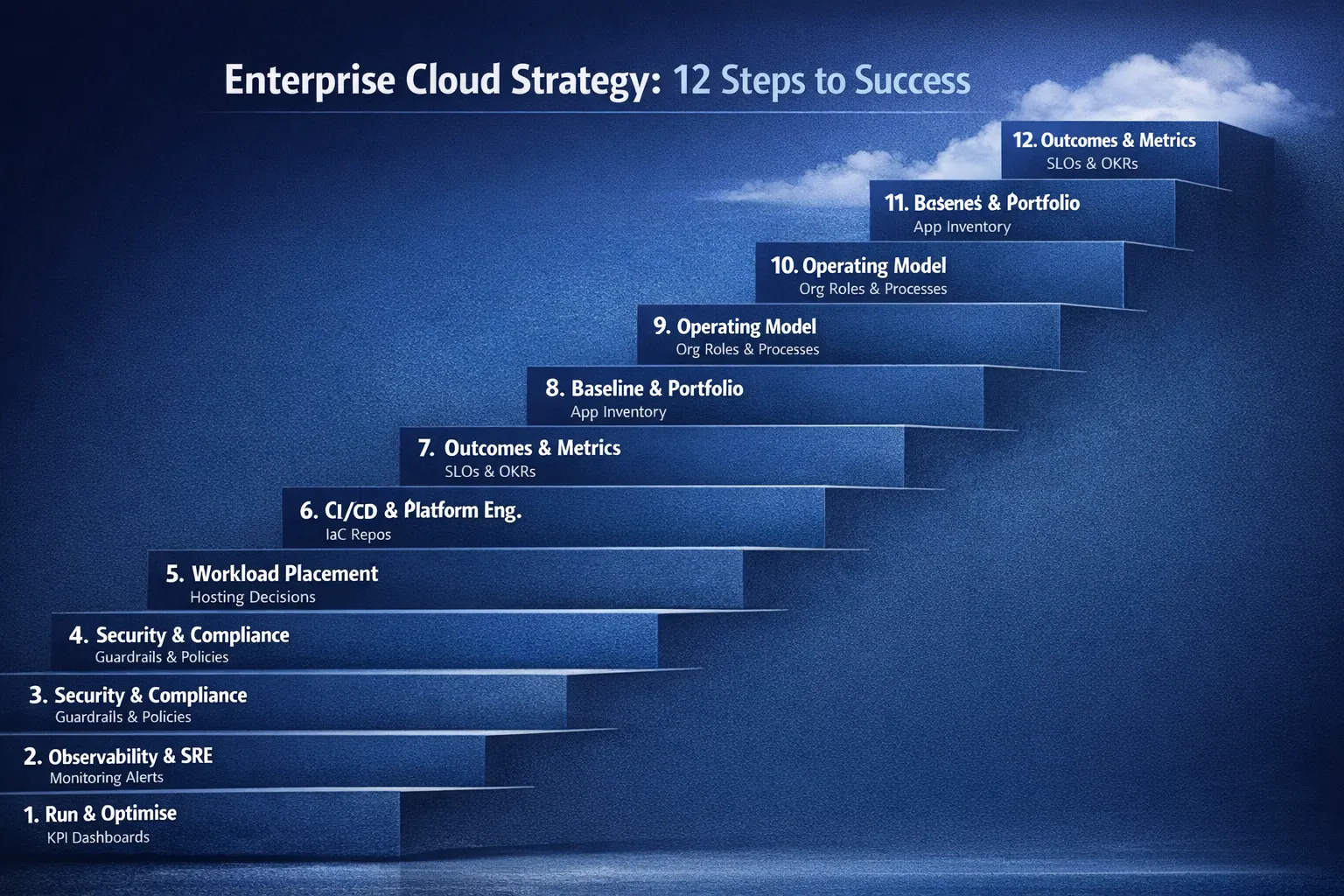
The rest of this article is a field-tested playbook to deliver those outcomes.
Step 1. Define outcomes and the metrics that prove them
Agree the business results you expect from cloud and how they will be measured. Keep it small and sharp.
| Outcome | Metric | Target example | Source of truth |
|---|---|---|---|
| Faster delivery | Deployment frequency | 2 to 10 per service per week | CI/CD logs, DORA dashboard |
| Shorter lead time | Commit to production lead time | Under 1 day p50 | VCS to deploy pipeline |
| Reliability | p95 latency and availability SLO | 250 ms p95, 99.9% monthly | APM, SLO tooling |
| Cost efficiency | Cost per request or per customer | Down 20% year on year | Billing export, tags |
Useful references: the DORA metrics for delivery and SLOs for reliability.
Deliverables:
- A one-page outcomes charter with 3 to 5 measurable targets and owners.
- A data plan naming where each metric will come from.
Step 2. Baseline your portfolio and total cost
Create a current-state picture so your strategy starts from facts, not assumptions.
- Catalogue applications, environments, integrations and data flows.
- Map dependencies and critical paths. Identify high-risk legacy components.
- Produce a cost baseline across compute, storage, network, licences, support and people.
- Tag workloads by business criticality and compliance needs.
Deliverables:
- Portfolio inventory, dependency map, and a cost baseline you can reconcile monthly.
- A risk register and technical debt log prioritised by impact and likelihood.
For KPI design ideas, see our guide to Cloud Service Management KPIs that matter.
Step 3. Choose your operating model and team topology
Cloud success follows operating model clarity. Decide how you will organise work and autonomy.
- Establish a platform engineering team that provides paved roads and golden paths.
- Define product or service teams that own services end to end, including runtime.
- Introduce SRE practices for reliability, on-call, SLOs and error budgets.
- Create a RACI for change, incident and security processes.
Deliverables:
- Operating model document, team charters, and an initial skills plan.
- Paved road definition for building, deploying and observing services.
Context: understand the distinctions between DevOps, SRE and platform engineering in our explainer on the differences between DevOps, SRE and Platform Engineering.
Step 4. Build a secure landing zone, as code
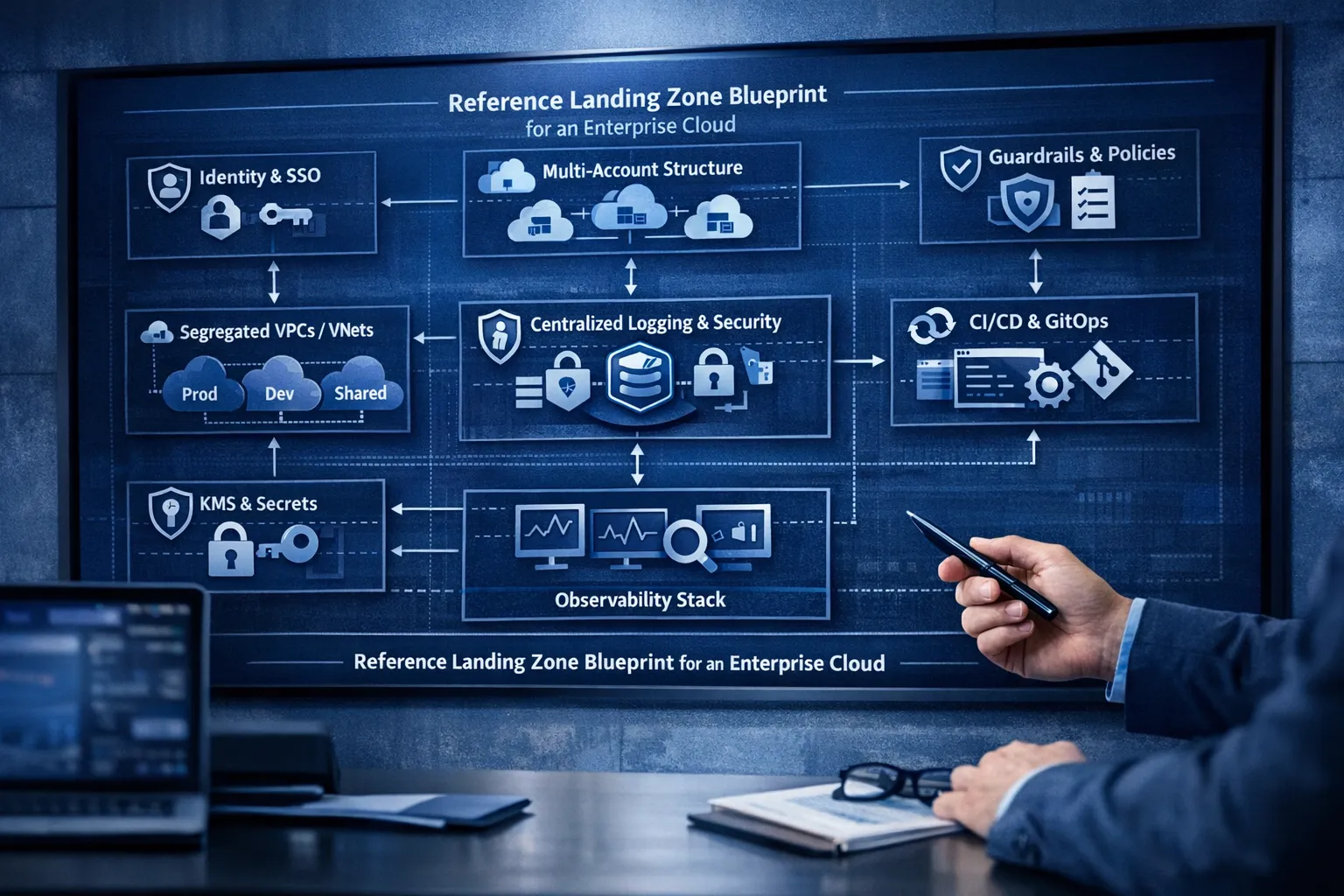
Your landing zone is the governed, multi-account or multi-subscription foundation for everything that follows.
- Identity and access, single sign-on, least privilege, break-glass accounts.
- Network segmentation, private subnets, egress control, service endpoints.
- Encryption by default, key management, secrets management.
- Baseline policies, guardrails and audit trails.
- Multi-account or subscription structure for isolation and blast-radius reduction.
Deliverables:
- Landing zone implemented as Infrastructure as Code with version control and CI.
- Policy-as-code guardrails and automated drift detection.
See the AWS Well-Architected Framework and our practical blueprint for designing resilient cloud infrastructure on AWS.
Step 5. Bake in security and compliance from the start
Do not retrofit security. Align to recognised frameworks and automate controls.
- Map to NIST CSF functions and sector regulators. Instrument evidence collection.
- Secure software supply chain, SBOM, image signing and vulnerability SLAs.
- Zero trust identity, MFA, least privilege, short-lived credentials.
- Data classification, tokenisation, retention, DLP and cross-border rules.
- Threat detection, incident response runbooks, tabletop exercises.
Deliverables:
- Control matrix with testable checks, owners and verification frequency.
- Security-as-code in pipelines, plus continuous assurance dashboards.
Reference the NIST Cybersecurity Framework and use our Cloud Computing Security Checklist for 2025 to operationalise controls.
Step 6. Decide workload placement and modernisation approach
Create a repeatable decision record for each system, using pragmatic patterns.
- Apply the 6 Rs, with a bias towards replatform and refactor where value is clear.
- Standardise on containers for portability and velocity. Choose managed Kubernetes where appropriate.
- Isolate or retire low-value workloads to reduce blast radius and cost.
- For data stores, select managed services unless you have a proven reason not to.
Deliverables:
- Workload placement decisions, with architecture diagrams and cost deltas.
- A modernisation roadmap with dependencies and risk mitigations.
See how we enabled autoscaling and reliability under unpredictable loads in healthcare with event-driven Kubernetes in our story on implementing autoscaling with KEDA, and how consultant-led migrations avoided hidden costs in Kubernetes migration cost.
Step 7. Standardise CI/CD and platform engineering
Treat delivery as a product. Make the easy path the safe path.
- Trunk-based development with short-lived branches, automated quality gates.
- Immutable artefacts, environment parity and ephemeral test environments.
- GitOps for deployments, for example Argo CD, with automated rollback.
- Golden templates for service scaffolding, security checks and observability.
Deliverables:
- Reference pipelines, golden templates and developer documentation.
- Change management policy aligned to deployment automation and SLOs.
If you are moving to pull-based delivery, read our guide on why migrate to Argo CD.
Step 8. Establish your data and analytics foundation
Cloud strategy without a data strategy is incomplete.
- Define data domains, ownership and governance. Establish a catalogue and lineage.
- Choose managed analytics building blocks such as object storage, warehouses, streaming and lakehouse patterns.
- Standardise ingestion, transformation and quality. Embed privacy by design.
- Plan for real-time and batch use cases, and the telemetry required for AI readiness.
Deliverables:
- Data platform reference architecture and governance policy.
- Initial high-value analytics use cases with measurable ROI.
For an example of cost-effective analytics at scale, see how we accelerated queries and cut storage in our ClickHouse case study.
Step 9. Instrument observability and SRE practices
You cannot manage what you cannot see.
- Standardise logs, metrics and traces. Create service-level objectives and alerts tied to user experience.
- Build dashboards for product owners and platform leaders. Track error budget burn.
- Automate incident response, on-call, post-incident reviews and learning.
Deliverables:
- SLOs per critical service, alerting policies and runbooks.
- An observability architecture deployed across environments.
Practical patterns and tools are covered in our overview on observability and effective monitoring and our multi-level monitoring approach.
Step 10. Implement FinOps and governance you can live with
Cloud economics is a capability, not a quarterly clean-up.
- Tagging and cost allocation coverage to near 100 percent for showback.
- Budgets, anomaly detection and commitment management where justified.
- Right-size, scale-to-zero, and delete unused resources as standard practice.
- Track cost per unit and cost per feature to link spend to value.
Deliverables:
- FinOps operating cadence with monthly reviews and action backlog.
- Dashboards for allocation, waste, savings realised and forecast.
Learn more from the FinOps Foundation and apply quick wins from our guide to Kubernetes FinOps.
Step 11. Plan migration waves and reduce change risk
Move in waves that create value early and de-risk complexity.
- Prioritise by business value, technical risk and dependency readiness.
- Build canary, blue-green and feature flag strategies into plans.
- Run readiness reviews, game days and rollback rehearsals.
- Keep a freeze calendar for material business events.
Deliverables:
- Wave plan with scope, SLOs, capacity plan and rollback criteria per wave.
- Executive-ready risk register with mitigations and owners.
Example wave plan fields:
| Wave | Scope | Dependencies | SLO target | Rollback trigger |
|---|---|---|---|---|
| 1 | Low-risk web apps | CDN, SSO | 99.9% | p95 latency above 400 ms for 15 minutes |
| 2 | Payments API | Tokenisation, KMS | 99.95% | Error rate above 2% for 5 minutes |
Step 12. Run, optimise and evolve
Make continuous improvement routine.
- Monthly ops and product reviews across reliability, speed, cost and security.
- Regular chaos experiments, capacity reviews and patch management.
- Retire services aggressively to keep cognitive load manageable.
- Refresh strategy yearly based on metrics and market shifts.
Deliverables:
- A living roadmap and quarterly OKRs aligned to outcomes.
- Post-incident learning culture and documented improvements.
Sector note: high-intent consumer platforms
Traffic for consumer marketplaces is bursty and trust-sensitive. If you operate in financial services, think about quote spikes, compliance and payment security. For instance, insurance comparison platforms in the UAE face seasonal surges around renewals, and their cloud architecture must prioritise predictable latency, robust data protection and transparent failover to maintain customer trust.
30, 60, 90-day starter plan
Use this to begin, even if you are mid-journey.
| Timeframe | Focus | Outputs |
|---|---|---|
| Days 1 to 30 | Outcomes, baseline and landing zone | Outcomes charter, KPI data plan, portfolio and cost baseline, landing zone backlog and initial IaC |
| Days 31 to 60 | Operating model, security and delivery | Team charters, control matrix, first guardrails live, reference pipelines and GitOps path |
| Days 61 to 90 | First wave value | Wave 1 systems migrated, SLOs in place, FinOps dashboard live, exec scorecard online |
Common anti-patterns to avoid
- Tool-first thinking before you define outcomes and evidence.
- Big-bang migrations with no rollback plan.
- A single shared account or subscription that mixes dev, test and prod.
- Uninstrumented services and no SLOs, especially around peak events.
- Untagged resources and no cost ownership.
- Security after the fact. Audits will discover what users already felt.
Executive scorecard essentials
Create a one-page view that the C-suite can read in five minutes.
- Reliability: SLO compliance, p95 latency, MTTR and error budget burn.
- Delivery: deployment frequency, lead time and change failure rate.
- Cost: cost per unit, allocation coverage and waste trend.
- Security: vulnerability MTTR, patch latency and control coverage.
- Platform health: incident trend and toil reduction.
How to instrument this well is covered in our guides to cloud KPIs and proving cloud ROI.
Why Tasrie IT Services
Enterprises ask us to help because we combine platform engineering, DevOps, security, data and FinOps into a single operating model that delivers measurable outcomes.
Where we typically engage:
- DevOps consulting and platform engineering to create paved roads and golden paths.
- Cloud native and Kubernetes enablement, including GitOps and SRE practices.
- CI/CD automation, Infrastructure as Code and migration execution.
- Security engineering, compliance alignment and continuous assurance.
- Observability, monitoring and incident response modernisation.
- FinOps programmes for cost visibility, savings and governance.
- Data analytics and visualisation foundations for insight and AI readiness.
You can see the results in stories such as our 30 percent EKS savings with spot optimisation, zero-downtime upgrades for analytics platforms, and major performance improvements through caching and query optimisation on global APIs, all available in our insights and case studies.
If you are ready to turn cloud plans into provable results, contact Tasrie IT Services to discuss your goals and constraints. We will meet you where you are, help you establish the foundations, and build a delivery rhythm that compounds value over time.